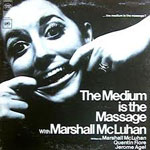
Professor Marshall McLuhan published a book that changed the way America looked at media: Understanding Media: The Extensions of Man (1964). He looked at the effects that the communication media had on society and human development. With each advance in human communications, different senses were used in unique manners. He warned that we should be aware of these changes and of the causalities and effects inherent in our technologies. McLuhan thought that media were extensions of a human’s mind, body and soul.
He broke down the media into “hot” and “cool” types. Hot media have more presentation of information, require the use of one sense over the others and need the viewer to participate less to understand the messages contained within. Films, radio, lectures and photography are some of his examples of hot media. Cool media are more detached and require the viewer to participate more actively with multiple senses to understand the meanings of the messages. Television, seminars and cartoons are some of McLuhan’s examples of cool media.
McLuhan controversially thought that the content of what was in those media didn’t affect society at all, but rather that it was the technology of the content delivery methods that made the major impacts. In his book The Medium is the Message: An Inventory of Effects (1967), Marshall McLuhan said, “All media work us over completely. They are so pervasive in their personal, political, aesthetic, psychological, moral, ethical and social consequences that they leave no part of us untouched, unaffected, unadulterated.” McLuhan prophesied in 1962: “The next medium, whatever it is—it may be the extension of consciousness—will include television as its content, not as its environment, and will transform television into an art form.”
What would McLuhan say about the communication media mix we have today? Would the internet be, by his standards, freezing cold? Let’s look at McLuhan’s ideas applied to what is happening today. In McLuhan’s last book, Laws of Media (1988), published after his death, he put forth a tetrad for examining communication media’s effects on society by dividing its effects into what has become known as the Four Laws of Media:
- Extension/Enhancement: Every technology extends or amplifies some organ or faculty of the user. What does the medium enhance or intensify?
- Closure/Obsolescence: Because there is equilibrium in sensibility, when one area of experience is heightened or intensified, another is diminished or numbed. What is pushed aside or obsolesced by the new medium?
- Reversal: Every form, pushed to the limit of its potential, reverses its characteristics.
- Retrieval: The content of any medium is an older medium.
Let’s ask these questions regarding the Internet:
- What does the medium enhance?
- What does the medium make obsolete?
- What does the medium retrieve that had been obsolesced earlier?
- What does the medium flip into when pushed to extremes?
The answers examine the language of media.
To examine this tetrad as it pertains to our media today, I did a qualitative survey and had 19 responses. I asked questions about the internet as a medium. The first question asked the participants how the internet enhanced or intensified their lives. The responses basically were grouped into two concepts: connecting with people and instant access to information around the globe. Those can be inserted into our tetrad in the Enhances box.
The next question was what is pushed aside or made obsolete by the internet? The responses showed that people think that the internet lessened direct human contact, getting information from traditional sources (TV, newspapers, radio), patience (everyone wants it NOW) and business etiquette and language. We can list those in the Obsolesces box.
The third question was: What does the Internet bring back to your life that was once obsolete? The responses included contact with friends and family far away, nostalgia for the past and being able to share views with the world. We can put those under the Retrieves box.
The final question that tied directly to this tetrad was: Every form, pushed to the limit of its potential, reverses its characteristics. If the internet were pushed to the limit of its potential, what might that look like? This is hard to conceptualize, but the responses included a loss in ability to think for ourselves, no physical life to speak of and that we will become the servers of the information. These go into the Reverses box.
So what does this show? It shows that the very things that make the internet so valuable can also be very dangerous when taken to the extreme. As McLuhan knew, this medium has evolved society by its widespread use. Here is one response: “We are a society that has taken every physical element of human transaction out. So we work online, we buy food, our necessities. We were halfway there already – I don’t think it is far off if we let it develop that way – thus removing the connectivity that it once created to bring people together- it will keep us apart.”
I asked a few more questions. Which types of devices do you use to communicate? It was a check all that apply situation. The highest percent use text and IM with 94.7 percent of the respondents choosing that option. Cell phones, email, desktops and snail mail all were chosen by 89.5 percent of the respondents. Surprisingly Tablets (with 52.6 percent) and Laptops (with 26.3 percent) were the most unpopular choices.
The next question on the survey was: On which devices do you watch/view content? Check all that apply. Tablets (with 94.7 percent) and desktops (with 78.9 percent) are the top getters in this question. Laptops (with 68.4 percent), portable media devices (with 24.3 percent) and cell phones (with 15.8 percent) complete the choices.
This next question sought to see if people were ready to embrace a brand new technology: When mobile TV broadcasting becomes widely available, will you plan to get a phone, dongle or device that will allow you to watch TV on the go? There were three answers to this one: Yes (10.5 percent), no (35.6 percent) and maybe (57.9 percent).
This one examines how people prefer to watch their TV content: Which of the following do you use to get your main video viewing? Cable is king with this group, as 52.6 percent use it compared to broadcast antenna and internet TV. Satellite was in the middle of the field with 21.1 percent and Netflix got 10.5 percent.
Along those same lines, I asked which source most people get the majority of their video content from. Traditional TV broadcast, cable or satellite got 42.1 percent, while internet videos got 10.5 percent and 47.4 percent answered they received their video from a combination of sources.
The final question: When you do watch video content online, which services do you use? Check all that apply. Everyone who took the survey uses YouTube; it was the most popular with 100 percent! TV network sites came in second with 68.4 percent of the responses. Netflix and Hulu each got 36.8 percent. Downloading files came in next at 31.6 percent. The least popular were iTunes (with 21.1 percent) and Xfinity.com (with 15.8 percent).
What does this all mean? The total impact of the internet on society is still a story writing itself, a work in progress, but Marshall McLuhan was a visionary and his theories make sense to this day. In my opinion, the results of the survey show that people are embracing the internet for information access and communication with friends and family, but they are not yet primarily looking to get their visual entertainment content from that medium. They still love the big screen, lay back viewing experience of watching network television over mostly cable and satellite delivery systems. Desktops are not dead… who knew?
So, is the internet a hot or cool medium? I think that the internet’s social media capabilities make it the coolest media that ever existed! If the medium is the message, then what is the internet saying? It is saying, “Reach out to the virtual world virtually and pull back from the physical world physically.”
I’d love to hear your thoughts on this!